Wednesday, March 27, 2013

More reason to teach mindfulness in schools

A study in the journal Psychological Science says that students who

had mindfulness training did better on the English portion of the GRE (graduate school entance exams) than those who didn't have it.

Forty-eight undergraduates were randomly assigned to either a mindfulness class or a nutrition class. Both classes met for 45 minutes, four times a week, for two weeks. During the mindfulness class, participants sat on cushions in a circle; they were asked to pay focused attention to some aspect of sensory experience, like the sounds of their own breathing. They practiced distinguishing between the simple thoughts that naturally arise in our minds (I have a test tomorrow) and the thoughts that become “elaborated” with emotion (I’m really worried that I won’t do well, and if I fail it, I’ll have to take the class over, and then I won’t graduate on time). The undergrads enrolled in the mindfulness class were taught how to reframe these more emotional concerns as mere “mental projections,” and how to allow their minds to rest naturally, rather than trying to suppress or get rid of their thoughts.

The results were clear: Participants who received mindfulness training showed improved accuracy on the GRE and higher working memory capacity, compared to those who received instruction in nutrition. Analyses indicated that the improvement could be explained, at least in part, by reduced mind wandering during the task.
The researchers estimated that mindfulness training resulted in the equivalent of a 16 percentile-point boost on the GRE, on average.


Study author Jonathan Schooler of the University of California theorizes that mindfulness may work by "dampening activation of the “default network,” a collection of regions in the brain that tend to become more active when our minds are at rest than when we’re focused on a mentally challenging task. Previous studies have found reduced activation on brain scans of meditators.
Schooler says this could have broad implications for learning: A number of recent studies have indicated that IQ can be increased through targeted interventions like this one, he says.

“The present demonstration that mindfulness training improves cognitive function and minimizes mind wandering suggests that enhanced attentional focus may be key to unlocking skills that were, until recently, viewed as immutable.”

Wednesday, March 20, 2013

Wishing and hoping and praying

What keeps you from relaxing into the present moment, accepting what's around you?

This article from psychcentral.com describes three ways we avoid being present with what's going and why they can create problems:

Wishing: When you wish upon a star ... Make a wish before you blow out the candles .. Throw a coin in the fountain and make a wish. "There’s probably no harm in wishing unless you find yourself constantly wishing life were different and experiencing a chronic discontent.  Consistently wishing things were different is non-acceptance of what is. When you are wishing for life to be different you may be missing out on the life you have. In addition, for some people, wishing builds dissatisfaction and suffering."

Complaining: "When you complain repeatedly, you are focused on what you don’t like about your world." No wonder you keep finding more things to complain about.

Avoiding: "When you are mindful, you notice your fear and do not let it control you in ways that are not consistent with reality."

Try going for an hour or a day noticing when you are  complaining, shoulding, or wishing things were different.  Notice and bring yourself back to the present moment and reality. Acceptance is not about agreeing with the way things are; it is simply an acknowledgement that reality is what it is. You can accept what is and still work to change it.

Friday, March 15, 2013

Meditation doesn't have to look like meditation

I'm traveling this week, which disrupts my usual meditation habit. normally I meditate in the morning for about 15 minutes and in the evening for about 30 minutes. I still meditate in the morning, sitting on a folded blanket on the bed, a book with a picture of Tara propped on a pillow as an altar.

Since I'm spending the day at a symposium, the days are full and long. My usual after-dinner meditation time is spent in a lecture hall, listening, processing.

I had a couple of hours free in the morning -- free, as in, find food, coffee, and -- auspicious coincidence -- chocolate. As I walked through the downtown, I was captivated by the public art, the atmosphere, the abundance of benches, the view of the river.

Sitting on a bench, I thought, I should meditate here. And I laughed internally. Crossing my legs into lotus position would not have made me more present than I was.

Meditation doesn't have to look like meditation. it just has to feel like meditation: fully present, not caught in thought or projection, aware of what's going on around you, resting in the present 


Thursday, March 7, 2013

Beditation


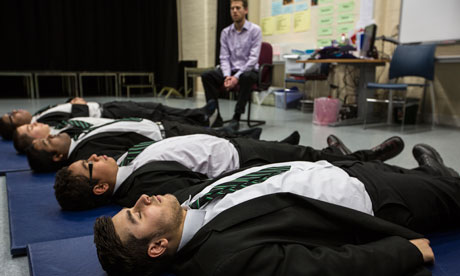
Schools in the United Kingdom are teaching mindfulness meditation to help students deal with stress, like test anxiety. This article in The Guardian says that about 3,000 students already have been taught meditation, and the number is growing.
Beditation at Bethnal Green. (Guardian photo)


The program was started by two teachers, Richard Burnett and Chris Cullen, who together formed the Mindfulness in Schools Project in 2007. "We were both finding great benefits from mindfulness ourselves," says Cullen, "and had started introducing simple mindfulness practices to classes in the schools where we taught. The response from students was striking and inspired us to create a programme that they would find fun, accessible, and of genuine use in their lives."

The program is called ".b" (Stop, Breathe and Be), and include techniques such as the "7/11" ( counting to seven on the in-breath and 11 on the out-breath) and "beditation," or meditation done lying down -- in jackets and ties.
 "Young people live in a fast-paced and confusing world," says head teacher Jenny Stephen. "The expectations that parents and society place on students are so high. To be able to step back and appreciate yourself for who you are, and be able to stop the plates spinning is a gift. Mental well-being is at the root of being able to achieve anything."

Making meditation a habit

Lift, an iPhone app that helps people meet goals by tracking their progress, is offering a meditation challenge in March. It's also got some nifty data from those who've previously used it to get going on meditation.

Meditation has the power to change lives but many people say it’s too hard to do. We think the habit is just as easy to pick up as any other daily habit, maybe even easier.
For instance,
-- It takes 12 days to establish a meditation habit. 90 percent of those who made it to Day 12 continued. (Other habits Lift tracked from users: 11 days for flossing and 15 days for eating breakfast.)
-- Consistency matters more than quality. There are days where meditation doesn't feel meditative. What matters is to come back the next day.
-- Start small. Most Lift users meditated 3-5 minutes when they were beginning.
-- People are least likely to meditate on Saturdays.

Lift only tracks the habit, not the results. It's up to you to notice whether it's easier to settle, to find quiet space in your thoughts, to be less reactive during your day. 

Monday, March 4, 2013

30 percent of UK doctors prescribe meditation

This story from The Guardian talks about a study I've written about before, using mindfulness meditation to turn down the volume on sensations.

Mindfulness gives patients control over this habitual chain via a "body scan" technique, where patients systematically engage and disengage with the sensations in each part of the body. As they do so, alpha rhythms, which organise the flow of sensory information in the brain, increase and decrease. Kerr describes this as a "sensory volume knob" and it is this flexible focusing skill which, the paper proposes, "regulates attention so that it does not become biased toward negative physical sensations and thoughts, as in depression". Early Buddhists advanced a similar theory 2,500 years ago in a famous practice text called "Mindfulness of the body and breath."
The author, Mia Hanssen, continues, referring to the National Health System:
Thankfully, the secular antidote that the NHS has rolled out is far easier than the one the Buddha taught. You don't have to sit cross-legged, and the sessions, usually run by a clinical psychologist, take place once a week over a period of eight weeks.
Having recognised the health and cost benefits, some NHS trusts accept self-referrals, others accept referrals via GPs. The Mental Health Foundation, which has produced a list of some of the NHS-funded courses, estimates that as many as 30% of GPs now refer patients to mindfulness training.
However, these programmes are often bundled under "talking therapies" treatment, such as cognitive behavioural therapy (CBT), which is misleading since talking is exactly what mindfulness practitioners aren't doing.

And should you be in the UK and want to take some mindfulness training, the Mental Health Foundation has a fabulous website. Maybe the Affordable Health Care Act will start something too.

Friday, March 1, 2013

How to sit with anxiety

Sitting with anxiety is a hard thing to do; anxiety seems to demand that you do something -- not just sit. This blog post, on Wildmind Buddhist Meditation, explains the how and why very well.
The key is to keep bathing your amygdala in reassurance. One way to do this is to accept your anxiety. The amygdala actually responds to its own activity. it creates anxiety and then takes the symptoms of anxiety as a sign that something *must* be wrong. So if we can simply accept our anxiety, and accept that it’s OK to feel anxiety, then we cut out that feedback loop of getting anxious about anxiety. You can say to yourself, in a soothing tone of voice (internal, if you want), “It’s OK. It’s OK to feel this. Let me feel this.”